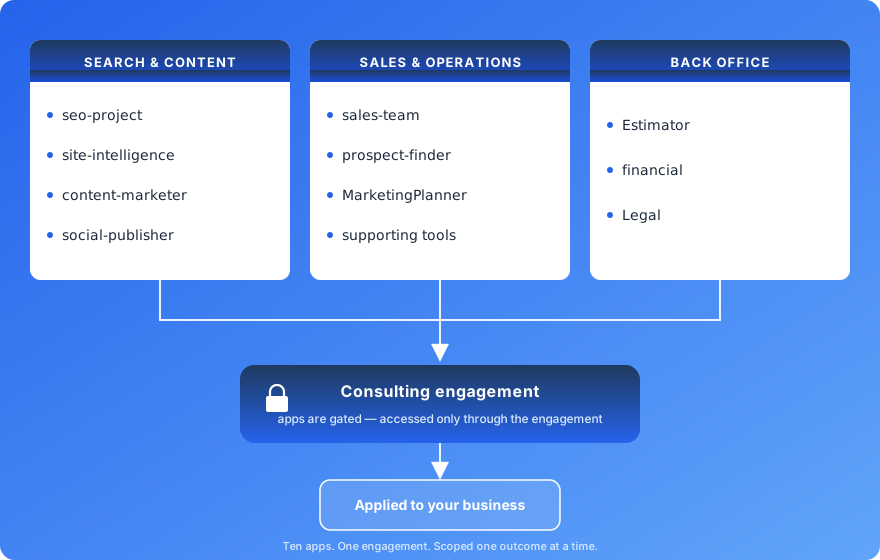
I have built ten AI apps for my own business. They run inside the operations of Villiers Vision Works every day. Searching, writing, prospecting, planning, estimating, accounting, contracting. Client access is through a consulting engagement, scoped to one outcome at a time. The apps and the engagement are the same thing; there is no separate product.
The pipelines have been refined inside the operator's own business across multiple production runs, including a 22-article governed content run on this site. The engineering recipe is documented here.
What follows is the catalogue. Three buckets, ten apps, plus the supporting tools that sit underneath them. Each card carries the same five fields: what the app does, what it produces, what it took to build, and how to access it. Skim it like a contents page; jump to whichever bucket matches the work you have in mind.
- Search & Content:
seo-project,site-intelligence,content-marketer,social-publisher - Sales & Operations:
sales-team,prospect-finder,MarketingPlanner, supporting tools - Back Office:
Estimator,financial,Legal
Search & Content
The four apps in this bucket plan search opportunity, audit the website, produce the long-form content that answers the buyer, and reshape what is approved into platform-ready posts. Together they are how a service page earns search and LLM-answer visibility and how a brand stays consistent across surfaces.
seo-project
Job. Maps the search opportunity for a target page or service. Output. Intent classification, query-to-page map, content cluster plan, competitive read against existing rankings. What it took to build. An opportunity model that deduplicates against pages the site already ranks for, an intent classifier that returns labels a writer can act on, and a cluster planner that respects existing topical authority. Six months of iteration. Not a keyword-volume tool with a coat of paint. Proof. This app maps the opportunity behind the engineered service landing pages on this site. The recipe is documented in the case study. Access. Private. Consultation only.
site-intelligence
Job. Reads a website the way a senior engineer reads a codebase. Output. Full HTML capture, screenshots, headings, link graphs, sitemap, schema audit, technical observations. What it took to build. A crawler with eval gates, a screenshot pipeline, a schema validator, and a sitemap differ that compares declared URLs against rendered pages. Six months of iteration. Not a Frankenstein wrapper around an open-source crawler. Proof. This app's audit underwrites the schema and canonical discipline used across the landing pages on this site. The recipe is documented in the case study. Access. Private. Consultation only.
content-marketer
Job. Produces governed long-form content with eval gates between every stage. Output. Briefs, drafts, governance logs. Every draft passes a no-AI-tell check, a no-invented-facts check, a signature check, and an internal-link check before it leaves the pipeline. What it took to build. A multi-stage pipeline (processor, scout, writer, editor) with an eval gate at every stage, a brand voice file that is enforced rather than suggested, and an editorial review step that kills drafts that fail. A 22-article governed run on this site is the proof of concept. Access. Private. Consultation only.
social-publisher
Job. Reshapes approved long-form content for downstream amplification. Output. Platform-shaped posts for LinkedIn, Facebook, X, and Instagram. Signature- and hashtag-aware per platform. What it took to build. A platform adapter set, a signature and hashtag manager per platform, and the same governance gates the long-form pipeline carries. Less work than the other three apps; included for completeness. Access. Private. Consultation only.
Want one of these applied to your business? Book the consultation.
Sales & Operations
Three apps plus a layer of supporting tools. They handle the work that sits between the website and the client. Opinion, prospecting, planning, and the data plumbing that the rest of the apps rely on.
sales-team
Job. A multi-expert panel that reviews positioning, messaging, and offer structure for a project. Output. Panel synthesis with cross-expert tensions surfaced, scorecards by domain variant, and a decisions log that is durable across conversations. What it took to build. An expert bench of eleven personas, retrieval over a project corpus, governance and project managers that keep panel sessions honest, and a decision-log discipline that means later sessions inherit earlier rulings without re-litigating them. Access. Private. Consultation only.
prospect-finder
Job. Finds and qualifies inbound and outbound prospects against a defined ICP. Output. Prospect lists with qualification notes, scored against the ICP, with reasons attached. What it took to build. A scraper, an ICP model that returns useful labels rather than theatre, an enrichment step against public sources, and a qualification gate that filters before a human reads anything. Access. Private. Consultation only.
MarketingPlanner
Job. Builds a marketing plan and budget against a stated business goal. Output. Channel plan, budget allocation across channels, milestone schedule, sanity-checked against unit economics. What it took to build. A planning template, a constraint solver that respects a budget cap, and a sanity-checker that flags channel mixes the unit economics will not support. Access. Private. Consultation only.
Supporting tools (e.g. prospect-scraper)
Job. The headless browsers, scrapers, and parsers that the apps above depend on. Output. Raw data (pages, listings, contact records) that the apps consume. What it took to build. Custom-built scraping, parsers per source, and storage that the rest of the system can query. Boring, but it is the layer that makes the apps non-fictional. Access. Used inside the engagement. Not a separate product.
Want one of these applied to your business? Book the consultation.
Back Office
Three apps that run the business itself. Estimating, accounting, contracting. Building these for my own operations is part of why the rest of the apps are credible. I trust them with my own money and my own legal exposure.
Estimator
Job. Produces a quote or estimate for a software or content engagement. Output. Itemised estimate with assumptions made explicit and risks called out per line item. What it took to build. A scoping template, a unit-cost model calibrated against fifteen years of delivered work, a risk register that the estimator pulls from, and an audit trail so a client can see why a number is what it is. Access. Private. Consultation only.
financial
Job. Bookkeeping, financial year closes, and audit preparation for the business. Output. Reconciled ledgers, FY summaries, audit-ready packs. What it took to build. A double-entry pipeline with bank-feed ingestion, a reconciliation gate that refuses to close a period with unmatched lines, and a FY assembler that produces packs an external auditor can read. Access. Private. Used inside the business. Applied to clients only where the engagement specifically calls for it.
Legal
Job. Drafts and reviews contracts, MSAs, NDAs, and POPIA-aware data agreements. Output. Redlines, draft agreements, review notes against a clause library. What it took to build. A clause library curated from real engagements, a redline engine that can read and reason about a counterparty's draft, and a POPIA-rule check for any clause that touches personal data. Access. Private. Consultation only.
Want one of these applied to your business? Book the consultation.
Why I built these
Twenty-five years in technology. Fifteen building production software for clients in the US, UK, Europe, Australia, and South Africa. E-commerce work on WooCommerce and Shopify, a POPIA-compliant medical and dental practice platform, and BX1X as my own SaaS business operations platform with 37+ modules. The kind of work that ships, runs under load, and survives audits.
Running my own SA-registered company since 2001 means I see software from the business-owner side. Scopes, quotes, deadlines, support tickets, cash flow, contracts, financial year closes. That is the side of the work off-the-shelf AI tools cannot help with, because they were not designed against it. So I built apps that were.
Three years of building with AI systems day-to-day, watching them produce confident output that turns out to be wrong. The strengths and failure modes of large language models are concrete to me, not theoretical. That is why these apps have eval gates, source-of-truth handling, and governance rules. They were built for my own business first. They produced real results. Applying the same systems for clients was the obvious next step.
The honest disclaimers
I built these for my own business first. I have applied the search and content apps to my own pages with proof. The other apps run inside my business operations day-to-day. I have not yet applied every app at full density to a client engagement. That work is in progress.
There is no guaranteed outcome promise on any of these apps. There is a defensible claim that working systems applied with judgement produce results, where generic AI tools have not.
FAQ
How many of these apps could you actually apply to my business?
As many as the engagement calls for. A typical engagement scopes one outcome (a ranking goal, a sales sequence, an estimating workflow) and uses whichever subset of the apps that outcome needs. Some clients only need seo-project and content-marketer. Some need the back-office set. We decide on the consultation, after the opportunity is verified.
Are these apps really yours, or are they wrappers around ChatGPT? Each app is a multi-stage pipeline with deterministic eval gates between stages. A single LLM call is one node inside one stage. The pipelines have source-of-truth handling, governance rules, and editorial or reconciliation gates that kill outputs that fail. A wrapper around ChatGPT cannot produce what these apps produce; it cannot run a 22-article governed content run end to end, and it cannot close a financial year without unmatched lines.
What if I only need one of them? That is fine. Engagements are scoped one outcome at a time. If your problem is one specific app's job, the engagement uses one app. The gating is the same either way: the app is not for sale, but it is applied for you inside the engagement.
If you want one of these applied to your business
Engagement scope is set during the consultation, after the opportunity is verified. Engagements are scoped one outcome at a time. Book the consultation.
I review every enquiry personally. I do not take every project. Fit is decided on the call. I will tell you on the call if it is not a fit.