
Services / Custom Platform Applications
Add the missing piece to the platform you already use.
Your WordPress, Shopify or WooCommerce site stays exactly as it is. I build the one part it can’t do.
Does this sound like you?
This is usually where the conversation about a stuck platform starts.
- “Our site does almost everything we need. It’s the one missing piece that’s costing us sales.”
- “We’ve stacked plugin on plugin trying to make this work, and now updates feel dangerous.”
- “A developer told us we need to rebuild the whole site. That feels like the wrong answer.”
- “We don’t want to lose years of content and search rankings over one missing feature.”
- “We need one specific thing, a calculator, a dashboard, a booking flow, that plugins just can’t model properly.”
What I’d do.
Look at what you already have.
Your platform, your plugins or apps, and the one thing it genuinely can’t do. That decides where the new piece should live.
Build that one piece first, safely.
You see the missing feature working on your own site, tested alongside the live site, before it touches anything customers use.
Add it in without disrupting what already works.
Your existing pages, content and search rankings stay in place. The new piece goes in around them, not over them.
Proof.
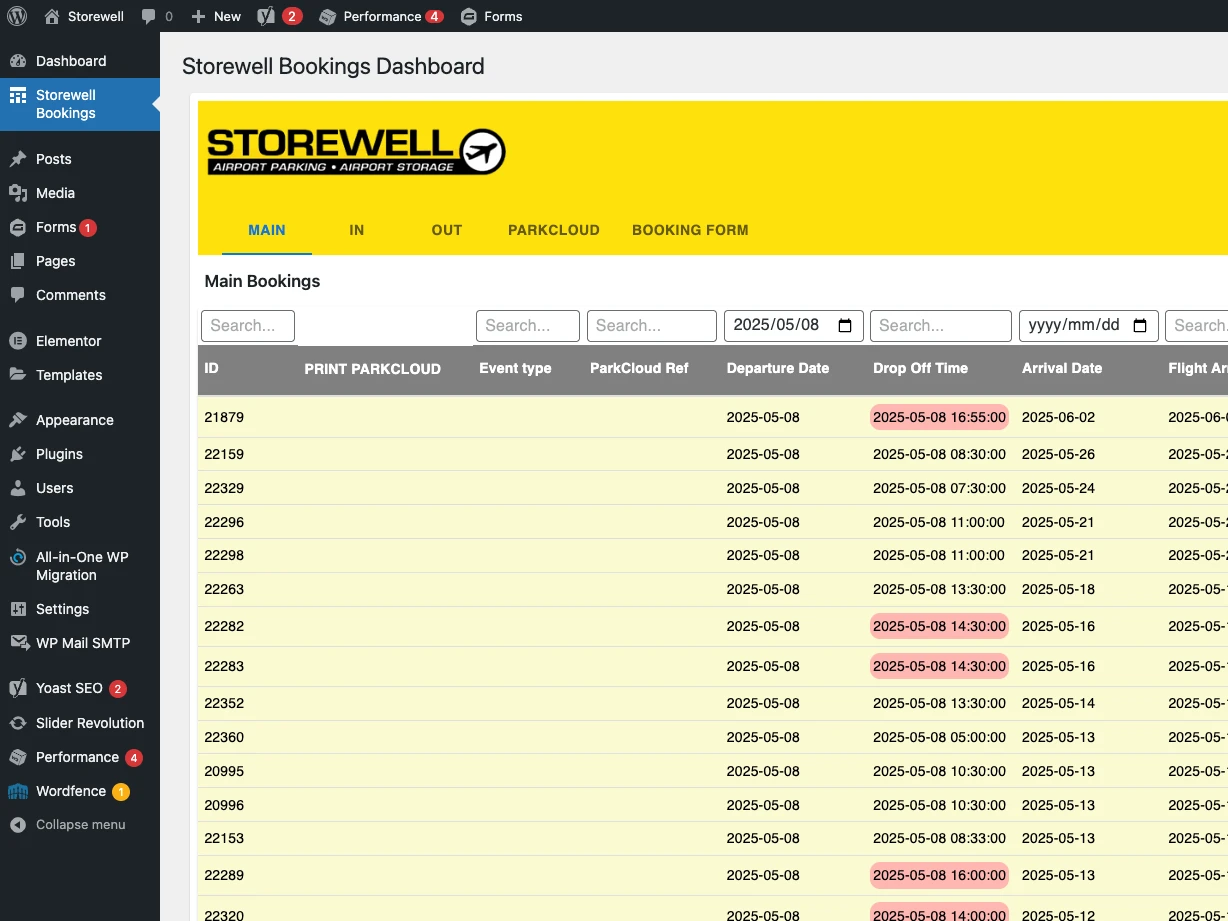
A booking system added inside WordPress, not a new site.
Storewell needed to manage real-time airport parking bookings. Rather than a separate system, the booking dashboard was built as a custom WordPress plugin, with a live sync to their parking supplier, so the WordPress site everyone already knew kept working exactly as before.
See the Storewell project →Stompies Wood, one payment rule added to checkout.
A WooCommerce store needed payments handled differently depending on the customer’s province, nothing else about the checkout or the site.
- The problemCape Town and Gauteng orders needed to be paid and routed separately.
- The fixThe existing WooCommerce payment plugin was customised to detect province and route the payment.
- What didn’t changeThe rest of the store, its products, content and checkout flow, stayed exactly as it was.
“Very experienced. Very thorough. Excellent communicator. Exceptional eye for detail.”
Michael CannonCreative Director, GOMEZ - ECOLAWYERS
How it starts, and what it costs.
You’re never committed to more than one piece.
- A free conversation.Tell me the platform you’re on, what it can’t do, and roughly how it should behave. No formal brief needed.
- The written plan.Where the new piece should live, what access it needs, what stays untouched, and a fixed quote for building it. Fixed fee, agreed in writing before it starts, and credited against the first piece. The plan is yours to keep.
- One working piece, at a fixed price.What I quote is what you pay for the agreed scope. Every piece after it is quoted before it starts, and you can stop after any piece and keep what’s built.
This is precise work, not a rebuild sold as an upgrade.
You don’t need a generalist selling you a new site. You need the missing piece built cleanly around the platform you already trust.
Not sure where to start? Answer seven short questions →For your technical person
Why this exists
Most businesses that need this kind of work do not need a new website. They need one custom piece of functionality their current platform cannot provide cleanly. This is like adding a custom room to a house, not demolishing it: if the platform is sound, extend it instead of replacing it.
What this covers
- WordPress custom applications: React-based tools, selectors, calculators, member workflows and admin interfaces embedded into WordPress without replacing the live site. Shortcode-injected frontends, plugin-based delivery, custom REST APIs, admin interfaces, custom data models.
- Shopify embedded applications: customer dashboards, credit systems, enrollment flows and API-connected business workflows. Embedded React applications, Shopify App Bridge, storefront integration, Admin API, Storefront API, ERP sync.
- WooCommerce extensions with real logic: custom selectors, pricing logic, customer portals, workflow tools and API-connected interfaces, while the catalogue, checkout and content setup stay in place. See WordPress and WooCommerce services.
- Dedicated API servers: some projects use platform APIs directly; others need a Node.js or PHP API layer, custom database tables or external business logic. See API and server work.
Why an application layer beats a full rebuild
- Keep what already works: existing content, search rankings and customer familiarity stay intact.
- Business rules, validation and workflow state belong in an application layer, not scattered plugin settings or theme code.
- Separated logic is easier and safer to extend later.
- The application still respects the platform’s own boundaries instead of fighting them.
Stack
React, Node.js, TypeScript, WordPress REST API, Shopify App Bridge, Shopify Admin API, Shopify Storefront API, PHP, PostgreSQL, MySQL.
Proof projects, in full
- Storewell, airport parking booking: custom WordPress plugin with a React SPA embedded in WordPress admin, custom MySQL tables, a custom WordPress REST API, Gravity Forms filters, and automated booking sync with the ParkCloud API. See the Storewell project.
- Stompies Wood, geo payment split: a customised WooCommerce payment plugin with province-aware routing logic, built and tested in Docker before deployment. See the Stompies Wood project.
- ICA, WordPress course selector: a state-driven course selection journey built as a custom React application inside WordPress, delivered as a modular plugin with a custom REST API and a separate admin interface for managing course data by state. See the ICA project.
- Truly Essential, Shopify credit system: a hybrid application layer around Shopify with embedded React interfaces, a custom API server, a custom balance ledger, and bidirectional Exigo ERP synchronisation. See the Truly Essential project.
- Optivest MedXpert: a React application embedded into WordPress as a portable plugin, using WordPress REST API endpoints and a Docker-based delivery workflow. See the MedXpert project.
How support works
Custom platform application projects fall into one of two buckets: a focused application extension (a specific selector, dashboard, workflow or tool added to an existing WordPress, WooCommerce or Shopify setup), or a broader integrated application layer involving APIs, custom data handling, admin interfaces or external systems. Each is quoted privately after the platform, access and boundary are understood, and larger layers start with the written plan. Everything stays in the client’s accounts, and every project ships with a handover pack.
Background
- 26years in IT
- 15+years building software
- 175+client reviews, almost all five stars
- Directsenior developer review
Read 101 of my 175+ reviews in full.
Also related
If you only need a basic BCEA-aligned payslip, not a full custom payroll application, the free South African payslip generator may be a simpler starting point than a custom build.
Specialist terms and job titles
Also described as: custom platform applications, custom WordPress application developer, custom Shopify app developer, custom WooCommerce application, custom web application developer Cape Town.
More background
- About Anton, the full story.
- Full project portfolio.
- Client reviews.
- Blog.
Questions owners ask.
Do I need to rebuild my site to add this?
Usually no. If your current platform already handles most of the business, rebuilding everything is often wasteful. I focus on building the one missing piece instead.
Will this break my existing WordPress, Shopify or WooCommerce site?
That’s the whole point of this approach. The existing site stays in place. The new piece is added around it as the right combination of frontend, plugin, API or backend logic, tested before it goes live.
Will my SEO and existing content be affected?
Not if it’s built properly. Keeping your existing content and search rankings intact while adding the new capability is one of the main reasons to choose this approach over a rebuild.
How does this work inside Shopify specifically?
Depending on what you need, it can run as an embedded application, a hybrid app, or a storefront-connected interface using Shopify’s own tools, designed around Shopify’s rules rather than forced into theme hacks.
Can you build custom payroll or HR features on top of our platform?
Yes. Payroll, HR, payslips, leave tracking and statutory workflows are common custom platform applications, added the same way as any other missing piece.
Is this the same as hiring a general web developer?
No, it’s narrower. The job isn’t “build a site”. It’s “add a custom piece to a platform that already works, without disrupting it”, which is a different way of thinking about the problem.
Related help.
Tell me what your platform can’t do yet. I’ll tell you the simplest way to add it.
+27 87 150 9305Monday to Friday, 09:00 to 20:00 SAST. Or email info@antondevilliers.com.