AI apps / Truescope
Truescope: my own proposal pipeline. I trust it to be accurate.
Truescope turns a client conversation into a priced proposal. Nothing reaches a client until I release it.
What it does
Truescope turns a messy client request into a priced, defensible proposal, fast and consistent, with nothing sent to a client until I’ve personally reviewed it. It’s an AI-governed custom proposal pipeline behind my own quoting, entirely separate from the free Project Estimator tool already on this site: one is a free public calculator, this is the system I use to run my own business, and they don’t share code.
How it works
- It gathers the real facts about the request. It’s built not to guess at budget, industry or features it wasn’t told.
- A staged review looks at the request from a few angles in sequence: scope, technical delivery, then pricing.
- Every material claim in the proposal is tagged as a verified fact, an assumption, an estimate or unknown, so I can see which parts are solid and which need a second look.
- Pricing, options and a phased plan get saved properly, not left in loose files.
- Before anything is generated as a document, it’s checked: the arithmetic, the wording, the totals.
- It can become an invoice with payment tracking, and can be queued to email, but it stays in draft until I personally release it.
Why I call it accurate
Every quote runs through a dedicated pricing-honesty check, specifically so a price can’t quietly get shaved down to fit a client’s stated budget without that being flagged. A document is blocked from going out if it fails any of seven built-in checks: arithmetic, quantity and amount coherence, reconciliation, a rate floor, claim verification, containment and typography. That’s why I trust the pipeline, not because of a stated accuracy number, but because of what it refuses to let through.
Proof
Follow a request through scope, delivery planning, pricing and review. Switch views to inspect the governance checks and the resulting proposal. Every client, amount and status shown is fictional.
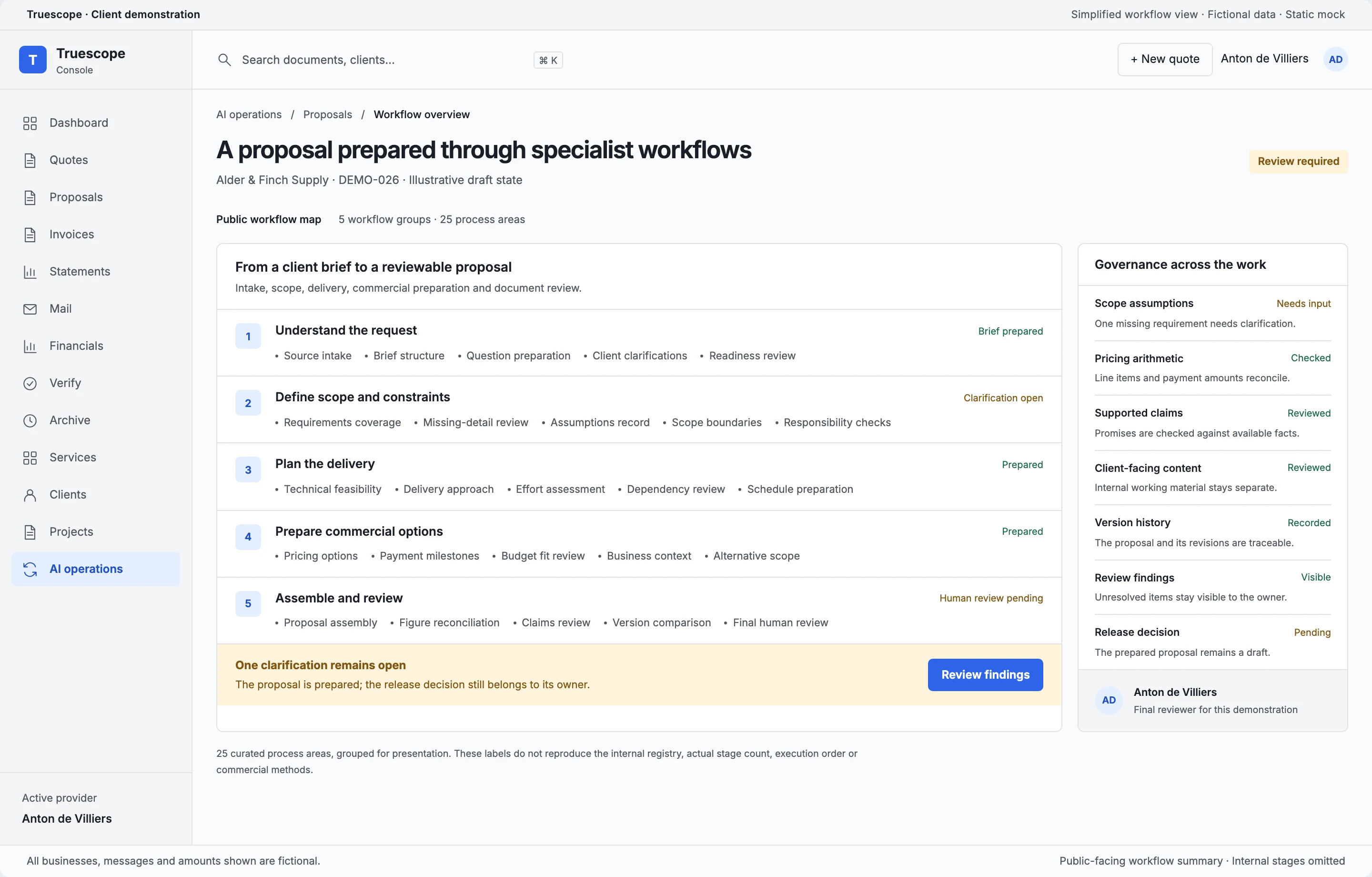
Pipelines. From client brief to proposal: 25 process areas across five workflow groups, covering scope, delivery, commercial preparation and document review.
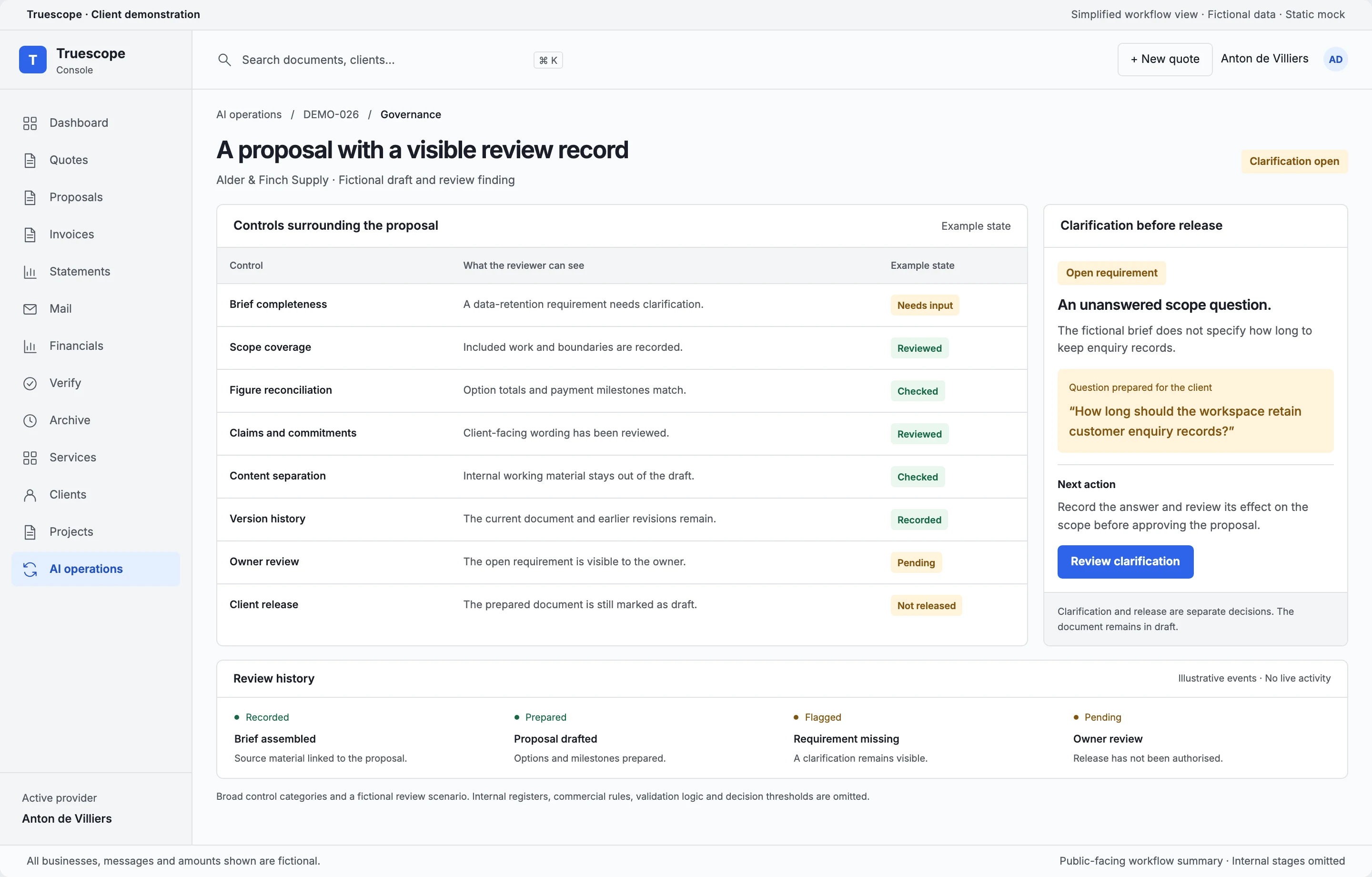
Governance. Scope, figures and claims are reviewed before release. An unanswered retention question stays visible until a person resolves it.
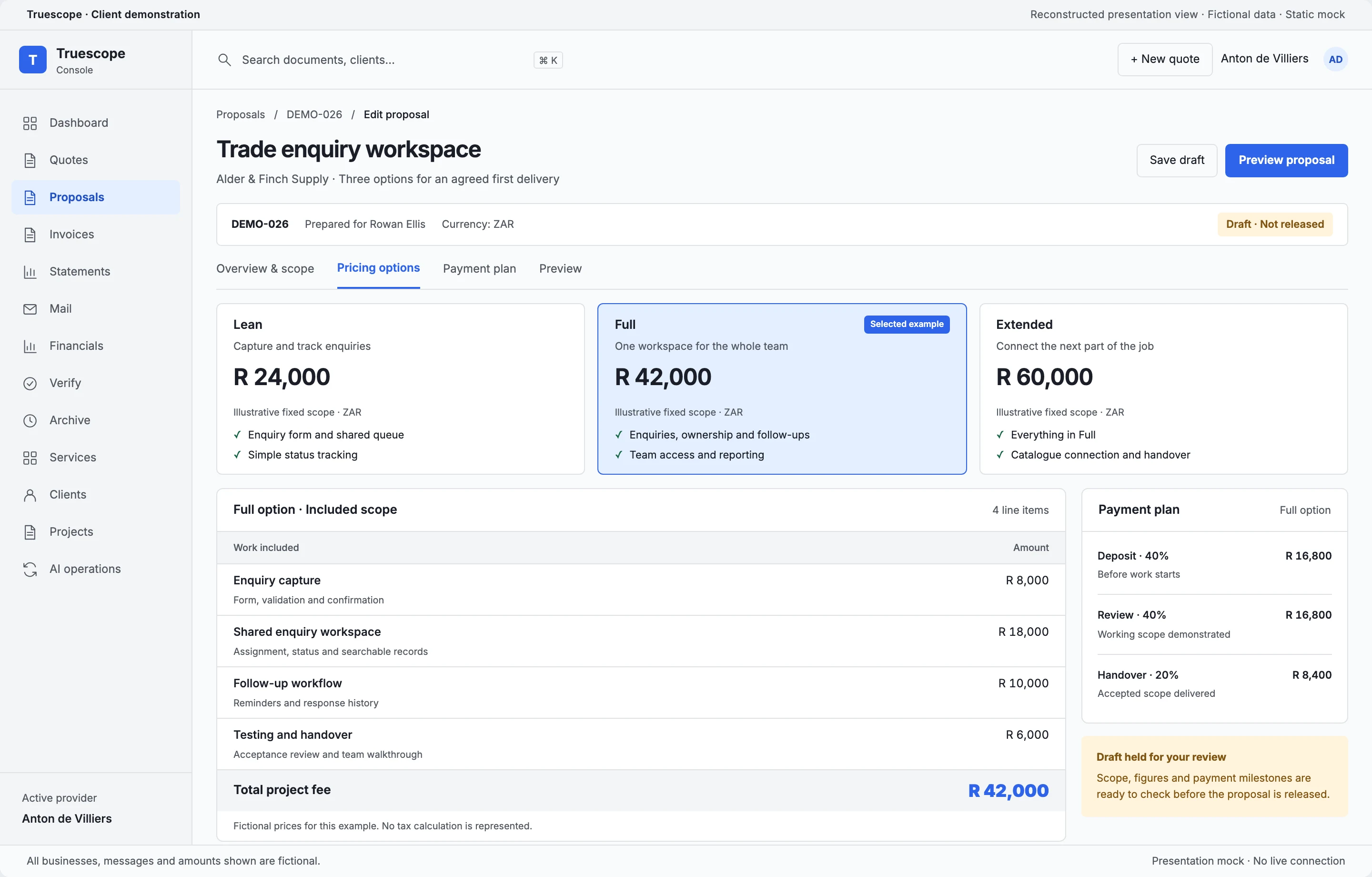
Proposal review. The proposal brings scope options, line items and payment milestones together. The amounts are fictional and the document remains a draft.
Reconstructed mockups with fictional data. The workflow groups summarise capabilities; they do not reveal internal pipeline definitions, prompts or decision rules.
For your technical person
Truescope is hosted and run on local or in-house physical servers. Its browser-based workspace brings proposal preparation, document generation and review workflows into the same deployment.
Separate pipeline stages handle request intake, scope, delivery planning, commercial preparation and document review. Checks cover scope completeness, arithmetic, totals and supported claims, with unresolved findings surfaced for review.
Prepared proposals can become invoices with payment tracking and queued emails. A person reviews and releases the output before it reaches a client, with outstanding questions and decisions recorded in the review history.
Related help.
Tell me about the project. I’ll show you how Truescope prices it.
+27 87 150 9305Monday to Friday, 09:00 to 20:00 SAST. Or email info@antondevilliers.com.